
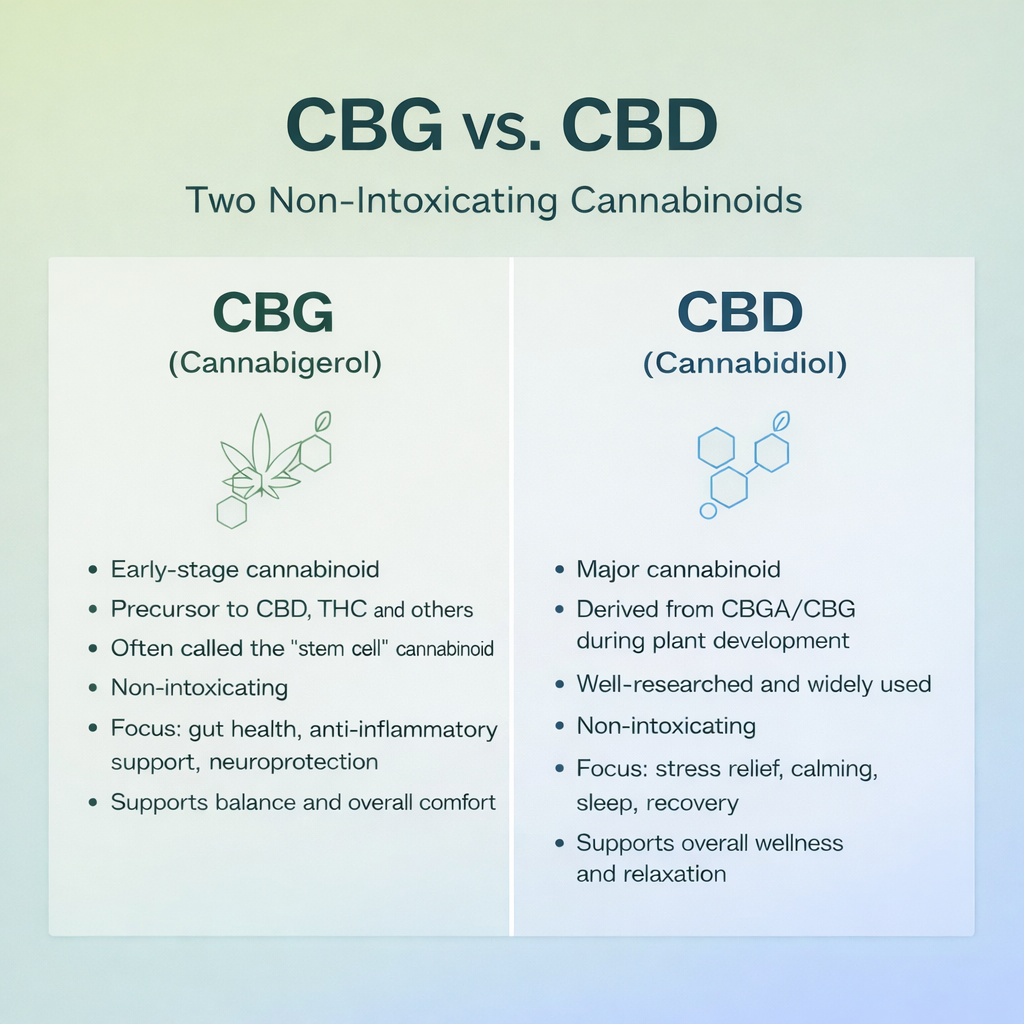
The wellness industry has seen a surge in interest regarding hemp-derived compounds. While Cannabidiol (CBD) is now a household name, another cannabinoid, Cannabigerol (CBG), is gaining attention for its distinct properties. Understanding the differences between these two compounds is essential for consumers looking to address specific health and wellness goals.
This article provides a scientific comparison of CBD and CBG, detailing their origins, how they interact with the human body, and their potential applications for targeted wellness.
The Origins: Where Do They Come From?
Both CBD and CBG originate from the cannabis plant, but their development pathways differ significantly.
The "Mother" Cannabinoid: CBG
Cannabigerol is often referred to as the "mother of all cannabinoids." In the early stages of the hemp plant's growth cycle, it produces Cannabigerolic Acid (CBGA). As the plant matures and is exposed to ultraviolet light and heat, CBGA breaks down and converts into the precursors for other major cannabinoids, such as THCA (Tetrahydrocannabinolic Acid) and CBDA (Cannabidiolic Acid).
Because most CBGA converts into other compounds, mature hemp plants typically contain very low concentrations of CBG—often less than 1%. This scarcity makes the extraction of CBG more resource-intensive compared to other cannabinoids.
The Dominant Compound: CBD
Cannabidiol is the non-psychoactive derivative of CBDA. In mature hemp plants cultivated for wellness purposes, CBD is usually the most abundant cannabinoid. Because it is present in high concentrations, extraction is more straightforward and efficient, contributing to its widespread availability in the market.
The Endocannabinoid System: Mechanism of Action
To understand the effects of these compounds, one must look at the Endocannabinoid System (ECS). The ECS is a complex cell-signaling system identified in the early 1990s. It plays a role in regulating a range of functions and processes, including sleep, mood, appetite, and memory. The ECS comprises three core components: endocannabinoids, receptors, and enzymes.
The two primary receptors are:
- CB1 Receptors: Found primarily in the central nervous system (brain and spinal cord).
- CB2 Receptors: Found mainly in the peripheral nervous system and immune cells.
How CBD Interacts with the ECS
CBD does not bind directly to CB1 or CB2 receptors. Instead, it influences the system indirectly. It inhibits the enzymes that break down endocannabinoids, effectively increasing the levels of the body's naturally occurring cannabinoids. This indirect action suggests why CBD is often associated with general balance (homeostasis) and broad-spectrum wellness benefits.
How CBG Interacts with the ECS
CBG acts differently. Research indicates that CBG interacts directly with both CB1 and CB2 receptors. This direct binding capability suggests that CBG may produce more targeted effects compared to the indirect influence of CBD. Because it binds to receptors linked to the nervous system and immune response, researchers are investigating its potential for more specific physiological applications.
Targeted Wellness Applications
While research is ongoing, current studies and anecdotal evidence point to distinct potential benefits for each cannabinoid.
Primary Applications for CBD
Due to its extensive study over the last decade, the applications for CBD are well-documented.
- Stress and Anxiety Management: CBD is widely used to promote relaxation. By influencing serotonin receptors, it may help manage daily stress levels.
- Sleep Support: Many users report that CBD helps regulate sleep cycles, potentially aiding those who struggle with falling asleep or staying asleep.
- General Inflammation: CBD is frequently utilized for its potential anti-inflammatory properties, making it a common choice for post-workout recovery and general joint support.
Primary Applications for CBG
CBG is currently being studied for more specific physiological interactions.
- Focus and Alertness: Unlike CBD, which is often associated with relaxation, anecdotal reports suggest CBG may support focus and mental clarity without the jittery effects of caffeine.
- Gut Health: Because CB2 receptors are abundant in the gastrointestinal tract, CBG is being researched for its potential role in supporting digestive health and managing gut inflammation.
- Appetite Stimulation: Some studies suggest CBG may stimulate appetite, which differentiates it from CBD (which generally has a neutral effect on appetite) and THCV (which may suppress it).
- Neuroprotection: Early preclinical studies have explored CBG's potential neuroprotective properties, looking at how it might support healthy brain function.
The Entourage Effect
While comparing CBD and CBG is useful, using them together may offer superior results. The "Entourage Effect" is a theory suggesting that cannabis compounds work better together than in isolation.
When CBD and CBG are consumed simultaneously—often found in "Full Spectrum" or "Broad Spectrum" products—they may enhance each other's benefits while mitigating potential side effects. For example, a formulation containing both cannabinoids might provide the calming physical effects of CBD alongside the mental clarity associated with CBG, offering a balanced approach to wellness.
Choosing the Right Option for Your Needs
Selecting between CBD and CBG depends on the specific wellness outcome desired.
- Choose CBD if: You are seeking general support for stress, sleep improvement, or systemic inflammation management. It is the more established choice for overall balance.
- Choose CBG if: You are looking for support with focus, energy, digestive health, or specific neuroprotective benefits.
- Choose Both if: You want to leverage the Entourage Effect for comprehensive support. Many broad-spectrum products naturally contain small amounts of CBG alongside high levels of CBD.
Safety and Regulation
Both CBD and CBG are non-intoxicating, meaning they do not produce the "high" associated with THC. However, consumers should verify the quality of any hemp product.
- Third-Party Testing: Always check for a Certificate of Analysis (COA). This document confirms the cannabinoid profile and ensures the product is free from pesticides, heavy metals, and solvents.
- Legal Status: Under the 2018 Farm Bill, hemp-derived products containing less than 0.3% THC are federally legal in the United States. However, state laws vary, so checking local regulations is necessary.
- Consultation: Before starting any new supplement regimen, consulting with a healthcare professional is recommended, especially for those currently taking medication.
Moving Forward with Cannabinoids
The hemp industry continues to evolve, moving beyond simple CBD products to more specialized formulations. CBG represents the next step in this evolution, offering targeted potential for specific health goals. Whether utilizing CBD for general balance or exploring CBG for focus and gut health, understanding the science behind these compounds ensures informed decision-making.
For those interested in exploring these cannabinoids further, NOVA Hemp offers a range of third-party tested products formulated to meet diverse wellness needs.



Share:
A Beginner's Guide to Dosing CBD Gummies for Optimal Wellness
How to Maximize the Benefits of Your CBD Cream